Permanent Linen Identification Guide for Rental Fleets
 By
By
Rental fleet operators know the challenge: linens move through dozens of hands, multiple venues, and commercial laundering cycles before returning to inventory. Without a reliable identification method, pieces disappear, counts take too long, and accountability becomes impossible. This guide covers the permanent linen identification methods used in commercial laundry and rental operations, including selection criteria for labels, RFID, attachment durability, tracking accuracy, and operational fit.
Whether you manage event linens, hospitality textiles, or a commercial linen service, the identification method you choose shapes every downstream process. The right approach reduces loss, cuts check-in time, and gives you visibility into your inventory at every stage.
Key Takeaways: Permanent Linen Identification Guide for Rental Fleets
- Permanent identification ties every linen piece back to your account, reducing field loss and speeding up crew sorting.
- RFID tags allow instant cart-level scanning, replacing manual counts with verified totals in seconds.
- Sewn-in fabric labels survive 200+ commercial wash cycles when rated for industrial laundering conditions.
- Ultimate Textile offers Labelcloth® labeling and RFID Linen Tracking built into production at no recurring fees.
- Matching your identification method to your workflow volume, read-point locations, and laundry environment determines long-term success.
What Is Permanent Linen Identification?
Permanent linen identification refers to any marking method designed to survive the full lifecycle of a textile in a rental or commercial laundry environment. This includes repeated washing, drying, pressing, folding, transport, and field use. Unlike temporary markers or handwritten tags, permanent identification remains legible and functional across hundreds of processing cycles.
The primary goal is accountability. When every linen carries a durable identifier, operators can track exactly what shipped, what returned, and what went missing. For rental fleets, this creates the foundation for accurate inventory management, loss prevention, and streamlined check-in processes.
Why Permanent Identification Matters for Rental Operations
Unidentified linens create operational friction at every touchpoint. Crews cannot sort efficiently when they cannot confirm ownership. Check-in slows down when staff must count each piece manually. Loss rates climb when there is no way to trace missing items back to a specific order or venue.
Permanent identification solves these problems by building accountability into every piece. Crews sort faster because each linen carries visible ownership data. Returns become verifiable because each piece can be scanned or visually confirmed. And loss prevention improves because operators can pinpoint exactly which items failed to return from each event.
For high-volume rental operations, the cumulative effect is significant. Even a 2-3% reduction in unreturned linens translates to measurable savings over a season. More importantly, crews spend less time on manual verification and more time on productive tasks.
Types of Permanent Linen Identification Methods
Commercial laundry and rental operations typically use one of four primary identification methods. Each has distinct advantages depending on volume, workflow design, and the level of tracking precision required.
Sewn-In Fabric Labels
Fabric labels made from polyester or textile material are sewn directly into the linen during production. These labels typically include the owner's name or logo, fabric content, and size information. Quality sewn-in labels resist moisture, abrasion, heat, fading, and chemical exposure from detergents.
When properly constructed, sewn-in labels survive 200 or more commercial wash cycles. The label becomes part of the garment, making it difficult to remove intentionally or accidentally. This method works well for operators who need visual identification at the crew level without requiring electronic scanning equipment.
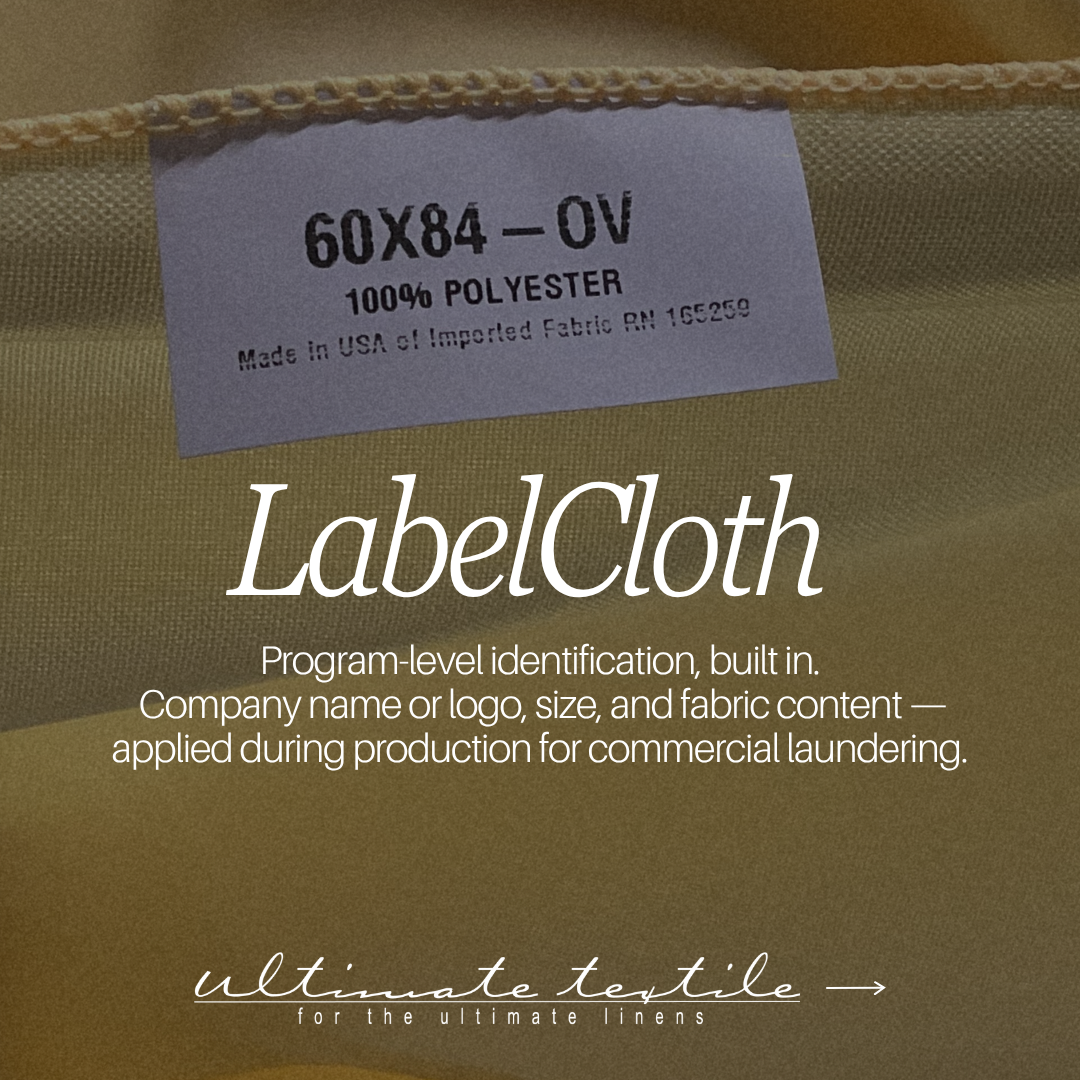
Ultimate Textile's Labelcloth® program prints the customer's name or logo directly onto size tags during production. Each linen ships finished with identification already in place. Labels are cut and sewn in Paterson, New Jersey, and rated for commercial processing.
RFID Tags
RFID (Radio-Frequency Identification) tags contain a small chip and antenna encased in a durable housing. Each tag holds a unique identifier that can be read by a compatible scanner without line-of-sight contact. Operators can scan an entire cart of linens in seconds, eliminating manual counting entirely.
RFID tags designed for laundry applications must survive water, commercial wash and drying temperatures, and extraction pressure. Most laundry-rated RFID tags have a specified lifespan of around 200 wash cycles, though some newer designs extend beyond that threshold.
The operational advantage of RFID is speed and precision. One pass with a handheld or fixed reader counts every tagged item in range. The system records exactly what was scanned, creating a verifiable record of shipments and returns. RFID Linen Tracking from Ultimate Textile adds a durable UHF tag during production for $2.00 per linen, with no subscription fees.
Heat-Sealed Labels
Heat-sealed labels use a heat-activated adhesive to bond directly to the fabric surface. A heat press or industrial iron applies the label, creating a permanent attachment without stitching. Heat-sealed labels work well on fabrics where sewing would be impractical or where a smoother finish is preferred.
Quality heat-sealed labels withstand washing, drying, and dry-cleaning cycles. They offer flexibility in placement since they do not require access for a sewing machine. However, the bond quality depends on proper application technique and fabric compatibility.
Pouch or Hem Insertion
For items with multiple fabric layers or defined hems, an RFID tag or small identifier can be inserted into an existing pocket of fabric. The opening is then sewn closed, concealing the tag entirely. This method protects the identifier from direct exposure to chemicals and abrasion.
Hem insertion works particularly well for tablecloths and napkins with finished edges. The tag remains hidden during use while still being readable by RFID scanners. The primary requirement is a defined hem or pocket that prevents the tag from migrating through the fabric during washing.
How to Select the Right Identification Method
Choosing the right permanent identification method depends on several operational factors. No single method fits every scenario. Operators should evaluate their specific workflow, volume, and tracking requirements before committing to an approach.
Consider Your Processing Volume
High-volume operations benefit most from RFID. When crews process hundreds or thousands of linens daily, the time savings from instant scanning compound quickly. Manual counting at that scale creates bottlenecks at check-in, packing, and laundry handoff.
Lower-volume operations may find that visible fabric labels meet their needs adequately. If crews can visually confirm ownership during sorting without scanning equipment, the additional investment in RFID infrastructure may not be justified.
Evaluate Your Read-Point Locations
RFID systems require read points where tagged items pass through a scanner. Common locations include doorways entering or exiting the laundry area, above or below sorting tables, on conveyor belts, or on the floor where laundry carts pass.
If your facility layout allows for strategic read-point placement, RFID can deliver real-time visibility into inventory movement. If your workflow lacks natural chokepoints for scanning, handheld readers offer more flexibility but require additional labor.
Assess Laundry Environment Conditions
Commercial laundering exposes identification materials to harsh conditions. Water temperature, detergent chemistry, mechanical agitation, and drying heat all affect longevity. Before selecting a method, confirm that the labels or tags you choose are rated for the specific conditions in your laundry process.
Some fabrics respond better to sewn-in labels than heat-sealed alternatives. Cotton-content textiles may require different adhesive formulations than 100% polyester. Testing a sample batch through your actual wash cycle reveals any compatibility issues before full deployment.
Match Tracking Precision to Operational Needs
Visual labels answer the question "whose linen is this?" RFID answers that question plus "how many pieces are here?" and "which specific pieces came back or went missing?" If your operation requires item-level tracking for loss prevention and inventory accuracy, RFID delivers that precision.
If your primary need is crew-level sorting and brand reinforcement at venues, visible labels may suffice. Many operators combine both methods, using branded labels for visual identification and RFID tags for automated counting and loss tracking.
RFID Implementation: Workflow Integration
Implementing RFID tracking requires planning beyond tag selection. The system must integrate into your existing workflow without creating new bottlenecks. Successful implementations typically establish read points at three key stages.
Outbound Orders
Before shipment, RFID scanning verifies that the packed order matches the customer's request. Each linen is scanned as it enters the shipping container. The system confirms the count and flags any discrepancies before the order leaves the facility.
Result: Eliminated under-shipments and packing errors. Operators know exactly what left the building, creating a verified baseline for returns.
Returns Processing
When linens return from an event, scanning at the receiving dock captures the inbound count immediately. Staff can compare the return to the original shipment record, identifying missing items before the rental closes out.
Result: Faster check-in, reduced labor hours, and clear accountability for unreturned pieces. Discrepancies surface immediately rather than during manual audits days later.
Laundry Handoff
Scanning at the laundry stage tracks inventory through the cleaning cycle. Operators can see which linens entered laundry, which are still in process, and which have returned to clean stock. This visibility prevents items from getting lost in the laundry backlog.
Result: Real-time visibility across the full linen lifecycle. No guesswork about where inventory is sitting at any given moment.
Label Durability: What Survives Commercial Processing
Not all labels perform equally under commercial laundry conditions. Operators should verify specific durability ratings before purchasing identification materials. Key specifications to confirm include wash cycle rating, temperature tolerance, and chemical resistance.
Wash Cycle Rating
Quality laundry labels specify a minimum number of wash cycles before degradation. A rating of 200 cycles at commercial temperatures is a reasonable baseline for rental operations. Some RFID tags and fabric labels exceed this threshold, lasting 300 cycles or more under optimal conditions.
Temperature Tolerance
Commercial dryers and finishing equipment reach temperatures that exceed residential settings. Labels and RFID tags should tolerate sustained commercial wash and dryer heat without adhesive failure, chip damage, or print degradation.
Chemical Resistance
Industrial detergents, bleach alternatives, and fabric softeners affect label materials differently. Polyester-based sewn-in labels generally resist chemical exposure better than paper-backed alternatives. RFID tag housings must similarly withstand the chemical environment without becoming brittle or cracking.
Cost Considerations for Permanent Identification
Permanent identification requires upfront investment in materials and potentially equipment. However, the return comes from reduced loss, faster processing, and improved inventory accuracy. Operators should evaluate total cost of ownership rather than per-unit label cost alone.
Label and Tag Costs
Sewn-in fabric labels typically cost less per unit than RFID tags. However, RFID tags eliminate manual counting labor, which often exceeds the tag cost over the item's lifespan. Ultimate Textile's RFID Linen Tracking adds $2.00 per linen during production, with no ongoing subscription fees.
Equipment Requirements
RFID systems require scanners and software to read and process tag data. Fixed readers mounted at doorways or sorting stations range from several hundred to several thousand dollars depending on read range and features. Handheld readers offer lower entry cost but require more operator involvement.
Visual label systems have no equipment requirements beyond the sewing or heat-sealing equipment used during production. Operators who already manufacture or source linens with labels may incur no additional equipment cost.
Labor Savings
The primary financial benefit of RFID comes from labor savings at check-in and inventory. Manual counting takes 2-5 seconds per item. RFID scanning captures an entire cart in a single pass. For operations processing thousands of linens weekly, the labor savings quickly offset tag costs.
Combining Identification Methods
Many operators find that combining visible labels with RFID tracking delivers the best operational outcome. Visual labels allow crews to sort by ownership at a glance. RFID provides the automated counting and loss tracking that visual inspection cannot match.
Ultimate Textile offers both Labelcloth® labeling and RFID Linen Tracking built into the production process. Labelcloth® prints the customer's name or logo onto every size tag at no per-piece fee. RFID adds scan-level tracking for operators who need precise inventory visibility and loss prevention.
This combination addresses both the human workflow (crews identifying ownership visually) and the system workflow (automated counting and record-keeping). Each method reinforces the other, creating a more complete identification solution than either method alone.
Common Implementation Mistakes to Avoid
Operators new to permanent identification often encounter predictable challenges. Avoiding these common mistakes improves adoption and long-term success.
Underestimating Tag Placement Importance
RFID read rates depend on consistent tag placement. Tags that migrate through loose hems or shift during washing become harder to read reliably. Secure the tag in a defined location during production, preferably sewn into a reinforced hem or dedicated pocket.
Skipping Compatibility Testing
Not every label or tag performs identically on every fabric. Polyester, cotton blends, and specialty weaves respond differently to heat sealing and laundering. Test a sample batch through your actual processing conditions before committing to full-scale deployment.
Overlooking Software Integration
RFID tags generate data. That data becomes useful only when captured and organized by compatible software. Before purchasing tags and readers, confirm that the system integrates with your inventory management or rental software. Disconnected data creates manual reconciliation work.
Failing to Train Crews
New identification systems require crew training to be effective. Staff must understand how to scan properly, where read points are located, and how to handle exceptions. A well-designed system with poorly trained users underperforms a simpler system with trained operators.
How Ultimate Textile Supports Permanent Identification
Ultimate Textile builds identification into the production process rather than treating it as an aftermarket add-on. This approach ensures consistent quality and eliminates the need for customers to source and apply labels themselves.
The Labelcloth® program prints the customer's name or logo directly onto size tags during production. Every tablecloth, napkin, or runner ships finished with ownership identification in place. Labels are laundry-safe and rated for commercial processing, surviving the conditions rental operators encounter daily.
For operators who need scan-level tracking, RFID Linen Tracking adds a durable UHF tag during production. Each tag carries a unique identifier that ties back to the customer's account. Operators using customer-provided scanners and software can count entire carts in seconds, eliminate manual recounting, and maintain accurate records of every shipment and return.
Neither program carries recurring fees: Labelcloth® has no per-piece fees, and RFID is $2.00 per linen, added during production. This predictable cost structure allows operators to plan identification expenses as part of their linen investment rather than an ongoing operational expense.
Measuring Identification System Performance
After implementing a permanent identification system, track key metrics to confirm it delivers expected results. The most relevant measurements vary by operation, but common indicators include loss rate, check-in time, and count accuracy.
Loss Rate
Compare unreturned linen rates before and after implementation. A well-functioning identification system should reduce loss by improving accountability and enabling faster identification of missing items. Track loss by customer, venue, and linen type to identify patterns.
Check-In Time
Measure the average time required to process returns before and after RFID implementation. Significant reductions indicate the system is delivering labor savings. If check-in time has not improved, evaluate whether read points are positioned optimally and crews are trained properly.
Count Accuracy
Compare counted returns to shipped quantities across a sample of orders. RFID systems should approach 99%+ count accuracy when properly configured. Persistent discrepancies may indicate tag placement issues, reader positioning problems, or software integration gaps.
Looking Ahead: Identification Technology Trends
Identification technology continues to advance, with improvements in tag durability, read range, and software integration. Operators investing in permanent identification today should consider how their chosen system can adapt to future developments.
Tag costs have declined steadily as manufacturing scales. RFID tags that cost several dollars per unit a decade ago now cost under two dollars for laundry-rated versions. This trend makes RFID increasingly accessible for operations that previously found it cost-prohibitive.
Software platforms are also maturing, offering better integration with rental management systems, automated alerts for missing items, and analytics dashboards that surface inventory patterns. Operators who establish clean identification data today position themselves to take advantage of these tools as they become more sophisticated.
FAQs About Permanent Linen Identification for Rental Fleets
How long do sewn-in fabric labels last in commercial laundry?
Quality sewn-in labels survive 200 or more commercial wash cycles when made from durable polyester and properly attached. Ultimate Textile's Labelcloth® labels are rated for commercial processing and sewn in during production for consistent durability.
What is the difference between labels and RFID for linen tracking?
Labels allow visual identification of ownership, while RFID enables automated scanning and counting. Labels answer "whose linen is this?" and RFID adds "how many pieces are here?" and "which specific items returned?" Many operators use both for complete coverage.
How much does RFID linen tracking cost?
Ultimate Textile adds a durable UHF RFID tag during production for $2.00 per linen. No subscription fees apply. Scanners and software are customer-provided, allowing operators to integrate with their existing inventory systems.
Can RFID tags survive commercial laundering?
Yes. Laundry-rated RFID tags are designed to withstand water, commercial wash heat, pressure during washing, and chemical exposure from detergents. Most have a specified lifespan of around 200 wash cycles, though some newer designs exceed that threshold.
What attachment method works for tablecloths?
Tablecloths work well with sewn-in labels or RFID tags inserted into the finished hem. Ultimate Textile sews identification and RFID tags into tablecloths during production, securing them in reinforced locations that survive commercial processing.
How does permanent identification reduce linen loss?
Identification creates accountability at every touchpoint. Crews can verify ownership during sorting, confirm counts at shipment and return, and trace missing items to specific orders or venues. This visibility discourages loss and accelerates recovery when items go missing.
Should I use labels, RFID, or both?
High-volume operations with frequent loss concerns benefit most from RFID. Smaller operations may find labels sufficient. Many operators combine both: Ultimate Textile's Labelcloth® for visual identification and RFID Linen Tracking for automated counting and loss prevention.